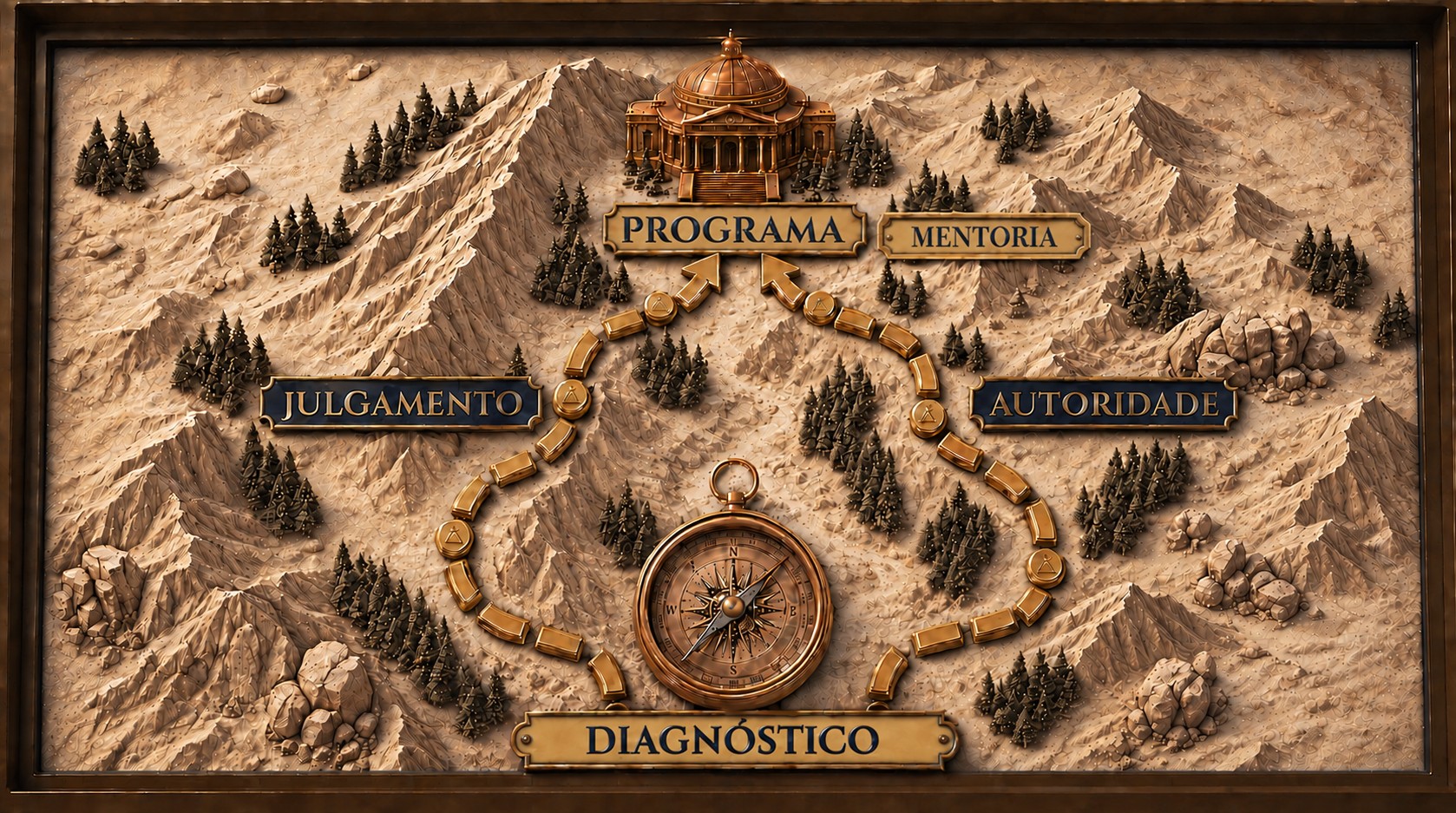
This isn't a course. It's mapped terrain — and the map beside it is literal, not decoration. The compass is the Diagnostic. The two trails are whatever is weighing on your week right now. The citadel at the top is the Program. Each point stands on its own, and all of them lead to the same place.
The three uses of "map" are deliberate. It's the same idea at three scales — and knowing which is which avoids the most common confusion for newcomers.
How the decision is made. The five letters that describe what changes in leaders who navigate the transition well. It's the content, and it doesn't date.
Where you pass through. The steps, from the free diagnostic to the executive program, in the order that makes sense. This is that product.
How it looks. The terrain drawn above, which exists because a path reads more clearly seen from above than read as a list.
The documented reason most executives fail in their first 18 months isn't technical incompetence. It's the inability to stop acting like a specialist.
You were promoted because you were the best on the team. That's exactly the problem. The role rewards whoever creates the conditions for others to do better than you would do alone.
That turn doesn't happen by osmosis. It has to be worked at.
*Harvard Business Review: between 35% and 40% of senior hires don't survive the first 18 months. The Corporate Executive Board, looking at some 30,000 leaders, arrives at 50%.
The Diagnostic points to one of the two. The question isn't which of them is more sophisticated: it's which one describes your week.
"I have to approve what I can't examine."
You approve what you can't examine. A vendor promise, a number from a study and a recommendation from your team arrive, and you have to say yes or no with no way to check. What's missing isn't technical knowledge: it's a yardstick that returns an answer per decision.
Starts with the Diagnostic →"I know what's right, and I can't make it stick."
You see the risk before the others and get steamrolled in the room anyway. You're called in after the decision has been taken, and your objection does not survive the first pushback. What's missing isn't judgment: it's position.
Starts with the Diagnostic →Developed over forty years inside four of the largest companies in the world. MAPPA isn't a stage acronym — it's the pattern I observed in every leader who made the transition well.
Five starting points, from free to corporate. Each one stands on its own — and all of them lead to the same place.
Reading
Facts with a source and a date, no maturity ladder. The most recent: What isn't written down becomes personal, on who answers when a decision no longer has an owner.
See all articlesPresence & Recognition
The Tech Summit · May 2026
Technology Modernization as a Strategic Lever
DCD>Brazil · Data Center Dynamics · Nov 2025
The new era of enterprises: how far can AI drive technology transformation?
Cidade Empreende · São José dos Campos · Apr 2025
Data and AI — Smart Decisions for the Future
Jump Talk #48 · Podcast · Nov 2025
How is Kenvue leading digital transformation with technology and AI?
Top 10 CTO of the Year
CIONET
Top 50 Executives in AI — 2025
7th Experience
Fifteen questions. A diagnostic of where you stand on two axes — judgment and authority — and the path that corresponds to it. If the answer is that you need no training at all, that's what the screen will say.
Take the free diagnostic →Free · Result on screen right away
When this is no longer your step
This page is about career trajectory. If your case is a different one:
Get to know the company behind the method
About Prædictor →